Índice
Why not every cable fastening solution is suitable for power cables
Cable fastening products are essential components of any electrical installation. They secure cables, support organized routing and help guide conductors along walls, structures and cable management systems.
For power cables, however, these functions are not always sufficient.
In electrical systems with high power levels, fault conditions can generate extremely high short-circuit currents. The resulting electrodynamic forces act directly on the conductors and create significant mechanical stress. If cables are not adequately restrained, they may move, deform or damage adjacent equipment.
As a result, engineers and operators must consider not only cable routing, but also the ability of the fastening system to withstand short-term extreme loads.
Cable clamps and cable cleats: understanding the difference
In power cable installations, it is important to distinguish between cable clamps and cable cleats.
| Term | Primary Function |
|---|---|
| Cable Clamp | Routing, supporting and securing cables during normal operation |
| Cable Cleat | Securing power cables and resisting the electrodynamic forces created during a short-circuit event |
A conventional cable clamp is primarily designed to support and organize cable installations. It carries cable weight, reduces vibration and maintains defined cable routes.
A cable cleat performs these functions as well but is additionally designed and tested to withstand the mechanical forces that occur during short-circuit conditions.
The key difference is simple:
A cable clamp secures cables during normal operation. A cable cleat is designed to keep power cables safely in position even under short-circuit conditions.
For the assessment of these systems, IEC 61914 plays an important role. The standard defines requirements and testing procedures for cable cleats used with power cables, including their ability to withstand electrodynamic short-circuit forces.
What happens to power cables during a short circuit
In the event of a short circuit, the current rises within a very short time to many times the normal operating current. This generates strong magnetic fields, which create considerable forces between adjacent conductors.
These forces can cause power cables to:
push against one another,
pull them apart,
twist,
displace them or
cause them to swing.
The higher the short-circuit power and the larger the cable cross-sections, the greater the stresses that occur.
Uncontrolled cable movement can have various consequences. These include damaged insulation, high mechanical stresses on cable terminations and connections, and damage to switchgear, transformers or other equipment.
The purpose of a short-circuit-resistant cable fastening is to limit these movements and keep the cables in their intended position.
Where cable cleats are used
Cable cleats are used wherever high levels of electrical power are transmitted and significant fault currents may occur.
Typical applications include:
Transformers and transformer connections
Low-voltage and medium-voltage switchgear
UPS systems
Power distribution systems
Data centres
Industrial plants
Substations
Power stations
Wind farms
Solar farms
Battery storage systems
Transport and infrastructure projects
They are particularly commonly used on main supply routes where several single-core power cables run in parallel. In these configurations, the forces generated during a short circuit can be particularly high.
Why modern power supply systems place greater demands
Global demand for electrical power continues to increase. At the same time, power densities in industrial facilities, data centres, energy storage systems and infrastructure projects are rising significantly.
To accommodate these requirements, larger cable sizes and increasing numbers of parallel single-core power cables are being used. As transmission capacity grows, potential short-circuit currents and the resulting mechanical forces also increase.
As a result, engineers must consider more than electrical criteria such as current-carrying capacity and voltage drop. The mechanical stability of the cable installation has become an equally important factor.
Reliable power distribution therefore requires a coordinated approach in which cables, support structures and fastening systems are designed to work together.
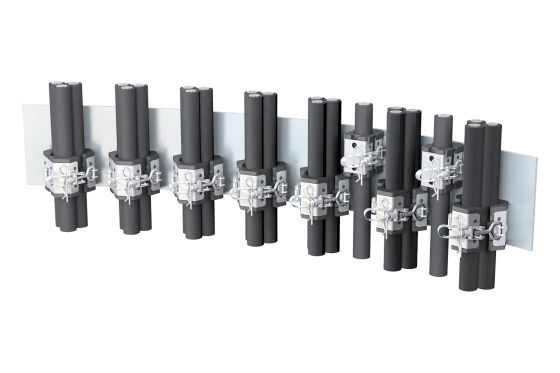
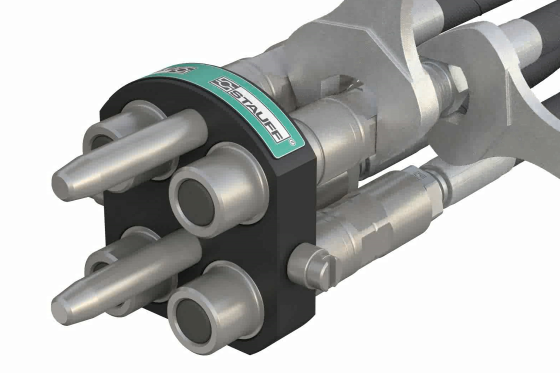
The STAUFF range includes so-called PCC clamps designed to meet these high requirements. PCC is an acronym derived from ‘Power Cable Clamps’.
Originally developed as WPC clamps (Wind Power Clamps) for the vertical mounting and securing of cables in the towers of wind turbines, the range is now significantly more extensive and designed to meet the most demanding requirements. This makes it ideally suited for use in critical infrastructure such as data centres and battery storage facilities, tunnels and transport infrastructure, or substations and power distribution systems.
Why cable ladders and cable trays are often the preferred installation solution
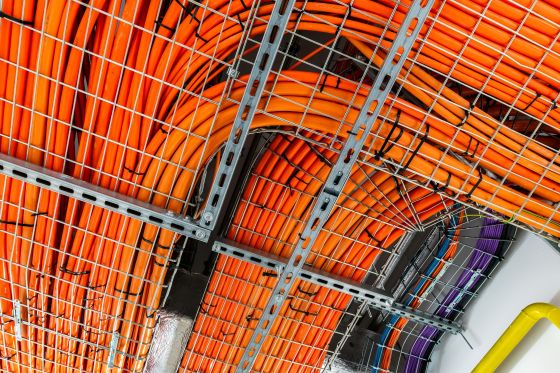
In high-performance power distribution systems, power cables are frequently laid on cable ladders or in cable trays.
There are several reasons for this. Cable ladders and perforated cable trays offer a high degree of flexibility when laying large quantities of cables, facilitate maintenance work and allow for future expansion. Furthermore, the open design ensures good accessibility and aids heat dissipation from the cables.
Further advantages include:
high cable capacity,
easy installation,
good visibility,
easy inspection,
flexible expandability.
As the cables are routed openly on cable ladders, they also provide ideal mounting points for short-circuit-proof cable fastenings. These can be fitted at defined intervals to hold the cables securely in place, even under high loads.
Cable clamps and cleats from STAUFF
Our range includes many clamps that are suitable for use as cable cleats. You can find all the relevant information here:
How short-circuit-proof cable fastenings improve safety and protect systems
Cable cleats are an important component of modern power supply systems. Whilst they do not protect against the short circuit itself, they do reduce its mechanical consequences.
As a result, they can help to:
limiting cable movement,
protect insulation systems,
reducing stress on connections,
protect transformers and switchgear,
minimising downtime,
to reduce maintenance costs,
to improve plant availability,
and enhance personal safety.
In critical infrastructure in particular, even a single fault can have significant economic consequences. Technically appropriate cable fastening therefore makes an important contribution to the reliability and operational safety of electrical installations.
FAQs
What is the difference between a cable clamp and a cable cleat?
A cable clamp is primarily used to support and manage cables during normal operation. A cable cleat is specifically designed to withstand the electrodynamic forces generated during short-circuit events.
What does the term cable cleat mean?
A cable cleat is a device used to secure power cables and maintain their position when exposed to short-circuit forces.
Why do mechanical forces arise during a short circuit?
High fault currents generate strong magnetic fields. The interaction of these magnetic fields results in forces between the conductors and thus in mechanical stresses on the cables.
Where are cable cleats typically used?
Cable cleats are commonly used in substations, switchgear installations, transformers, data centres, battery energy storage systems, wind farms and other high-power applications.
Are cable ties sufficient for securing power cables?
Cable ties may be suitable for organising and routing cables. However, they are generally not designed to withstand high short-circuit forces.
Why are cable ladders often used together with cable cleats?
Cable ladders provide flexible cable routing and easy access while also offering convenient mounting points for cable cleats.
When should cable cleats be considered?
Cable cleats should be considered whenever power cables may be exposed to significant fault currents and resulting short-circuit forces.
Can cable cleats prevent equipment damage?
While cable cleats cannot prevent the electrical fault itself, they can help reduce cable movement and limit mechanical damage to connected equipment.

Newsletter sign-up
Sign up now and never miss another post!