Índice
What the line routing says about the design quality
In hydraulics, pressure levels, volume flows, materials or connection standards are often at the centre of technical considerations. These parameters are decisive for the performance of a system. However, during customer inspections, factory acceptance tests, trade fair appearances or the handover of machines, another aspect is often decisive: the external appearance of the tube, pipe and hose routing.
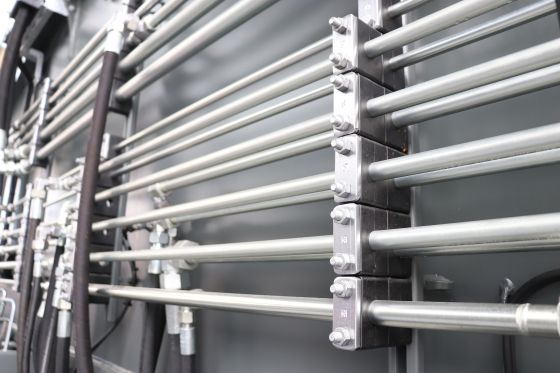
Clearly routed lines, even spacing and stable fastening convey control, reliability and design maturity. Irregular runs, loosely attached tubes or pipes or a visually uneven overall appearance, on the other hand, quickly appear unfinished - even if the technical function is given. The pipe routing thus becomes a visible indicator of the perceived quality of a hydraulic system.
Tube, Pipe and hose clamps as a constructive element in hydraulic design
In practice, a hydraulic system is far more than a collection of connected components. Particularly in applications such as construction machinery, hydraulic power units, automation solutions or maritime systems, tight installation spaces, vibrations and complex pipework come together. Planning the tube, pipe and hose routing therefore becomes a design task in its own right.
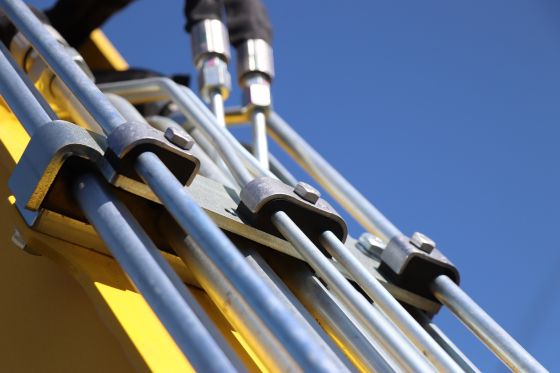
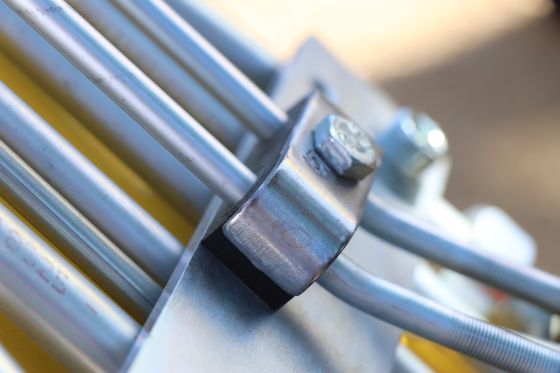
Tube, Pipe and hose clamps play a central role in this context. They not only fix cables in place, but also define the structural logic of the routing - especially for parallel cables and changes of direction. Their positioning has an influence:
the stability of the cables under dynamic loads
the reduction of vibration-induced movements
Uniform alignment of tubes, pipes and hoses
the clear demarcation of functional areas
Tube, Pipe and hose clamps are therefore not a subordinate accessory, but an integral part of an organised and comprehensible hydraulic design.
Why standardised tube, pipe and hose clamps improve practice
Standardisation in hydraulics is not limited to dimensions or materials. It also influences assembly processes, maintenance procedures and long-term operational safety. Standardised tube, pipe and hose clamp systems create a uniform selection and installation logic across different projects and markets.
Consistent clamp types and sizes enable defined distances and consistent alignment of the lines. This ensures a calm, tidy appearance and at the same time supports the behaviour of the cables under vibration and load. Movements are limited, collisions are avoided and long-term wear is reduced.
The advantages of standardised fastening solutions are also evident when servicing is required. Clearly structured cable routing makes it easier to locate individual cables, reduces the risk of errors and shortens downtimes. Purchasing and spare parts management also benefit from clearer parts lists and predictable spare parts availability.
Why tidiness in pipe routing influences competitiveness
Modern customers do not evaluate hydraulic systems solely on the basis of technical performance data. The overall impression of the design also plays a role in their perception. Two systems with comparable specifications can be judged very differently if one stands out due to improvised fastenings and disorganised pipework.
A structured, comprehensible tube, pipe and hose system signals design maturity, technical control and attention to detail. This confidence is not created by individual components, but by the sum of consistency, order and clean execution. Pipe, tube and hose clamps play a visibly fundamental role in this.
Practical benefits of clamps in everyday system operation
In day-to-day operation, the added value of well thought-out fastening is demonstrated by specific issues:
Are tubes, pipes and hoses securely fastened under real operating conditions?
Is the cable routing logical and easy to follow?
Does the system appear professional during inspections and approvals?
Can maintenance and service work be carried out efficiently?
Pipe, tube and hose clamps have a direct influence on all these aspects. Their contribution ranges from operational safety and ease of maintenance to the perceived quality of the entire system.
How well thought-out fastening concepts characterise system quality in the long term
The difference between a system that merely works and one that appears mature and reliable often lies in seemingly minor design decisions. Carefully planned cable routing, a clear fastening logic and the use of standardised tube, pipe and hose clamps result in systems that remain stable, easy to maintain and visually appealing in the long term.
Pipe, tube and hose clamps are not the only factor in the performance of hydraulic systems. However, they have a decisive influence on whether a system appears organised, comprehensible and professionally designed - and this is precisely where design quality is evident in the details.
FAQs
Why are tube, pipe and hose clamps important for hydraulic systems?
Pipe, tube and hose clamps securely fix lines, reduce vibration-induced movements and create a clear structure in the line routing. They contribute to operational safety, ease of maintenance and a professional overall impression.
How do tube, pipe and hose clamps influence the visual quality of hydraulic systems?
Uniform spacing and standardised fastenings ensure a tidy pipe layout. This visual tidiness has a significant impact on perception during acceptance tests, deliveries and presentations.
What problems arise from poorly planned fastening concepts?
Inadequate or inconsistent fastening can lead to cable movement, abrasion, difficult identification, limited maintenance accessibility and a disorganised appearance.
Why are standardised tube, pipe and hose clamp systems used?
Standardised systems support uniform assembly processes, simplify the stocking of spare parts and ensure a consistent appearance and predictable behaviour under real operating conditions.
What influence do tube, pipe and hose clamps have on maintenance and service?
Clearly structured pipe routing makes it easier to find and access individual pipes. This reduces service times, simplifies installation work and lowers downtime costs.
Are tube, pipe and hose clamps only relevant for large hydraulic systems?
No. Suitable clamps also improve stability, safety and appearance in smaller systems and contribute to long-term reliability.
How do tube, pipe and hose clamps contribute to the competitiveness of machines?
A clean, well-structured pipe system signals technical discipline and attention to detail. This creates trust and differentiates machines in markets with comparable performance data.
What should be considered when selecting tube, pipe and hose clamps?
The main criteria are pipe and hose diameter, material compatibility, vibration load, ambient conditions and compliance with relevant standards. A suitable selection supports secure fastening and maintenance-friendly cable routing.

Newsletter subscription
Subscribe now and don't miss any new articles!